


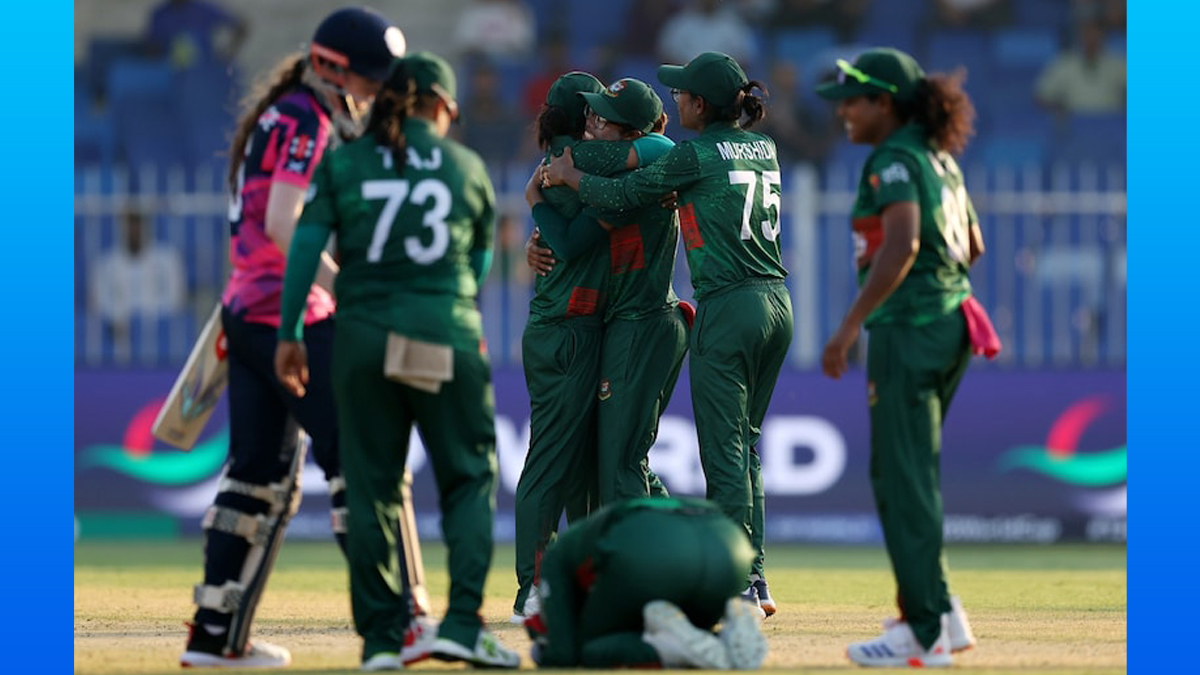
The Sri Lanka team has secured a victory in their second consecutive match of the ICC Women’s Emerging Nations Trophy, defeating Scotland by 4 wickets.
Having won both matches played so far, Sri Lanka has moved to the top spot in Group A.
After winning the toss, the team decided to bowl first, which allowed them to capitalize on the conditions offered by the surface early in the day.
They maintained control from the very beginning, reducing the opposition to 3 wickets for 21 runs during the 6-over powerplay, and 4 wickets for 36 runs by the end of the first 10 overs. The bowling attack consistently targeted the stumps, maintaining a tight length throughout. It would be fair to say that the control maintained during the first 10 overs diminished in the second 10. In that second phase, the team conceded 75 runs while taking only 4 wickets. The primary reason for this was a shift in the bowling approach; the tight, wicket-to-wicket lines that were sustained for the first 12 to 13 overs were not maintained thereafter. As mentioned previously, the pitches at the Karwan stadium offer very little assistance to bowlers; therefore, the key to success lies in maintaining consistent line and length while strategically incorporating variations. This explains the relative loss of control during the second 10 overs. Overall, restricting the opposition to 111 runs within 20 overs is a commendable achievement, especially on a surface that provides minimal support to the bowlers. Regardless of the slight dip in the second 10 overs, it remained a strong bowling effort—characterized by only 4 extras and just 5 boundaries—reflecting a disciplined display. That said, there were a few shortcomings in this performance compared to the previous match. The target was 112 runs. With 43 runs for the loss of one wicket in the 6-over powerplay, and 63 runs for two wickets by the end of the first 10 overs, they were well ahead of Scotland’s innings at that stage—and with wickets still in hand.
However, in the next 5 overs (30 balls), they lost 3 wickets for just 23 runs, creating unnecessary pressure and triggering a collapse in the innings.
Of the 5 wickets that fell, 3 were lost while attempting cross-batted shots against deliveries aimed straight at the stumps. The disciplined batting display seen previously—where wickets weren’t thrown away needlessly—was absent today. In short, many of the positive batting aspects from the earlier match were missing. Had certain situations been read correctly, this chase would not have been nearly as difficult to complete. Ultimately, they won the match by 4 wickets.





















































































































































































































































































































































































































































































































































































































































































































































































































































































































































































































































































































































































































































































































































































 English
 Sinhala